
Prague Travel Guide: 10 Must-Sees, Prices and a Day-by-Day Plan
What to see in Prague and how to plan it: real public transport fares, Prague Castle and Jewish Museum ticket prices, how to get in from the airport, and one-, two- and three-day itineraries.
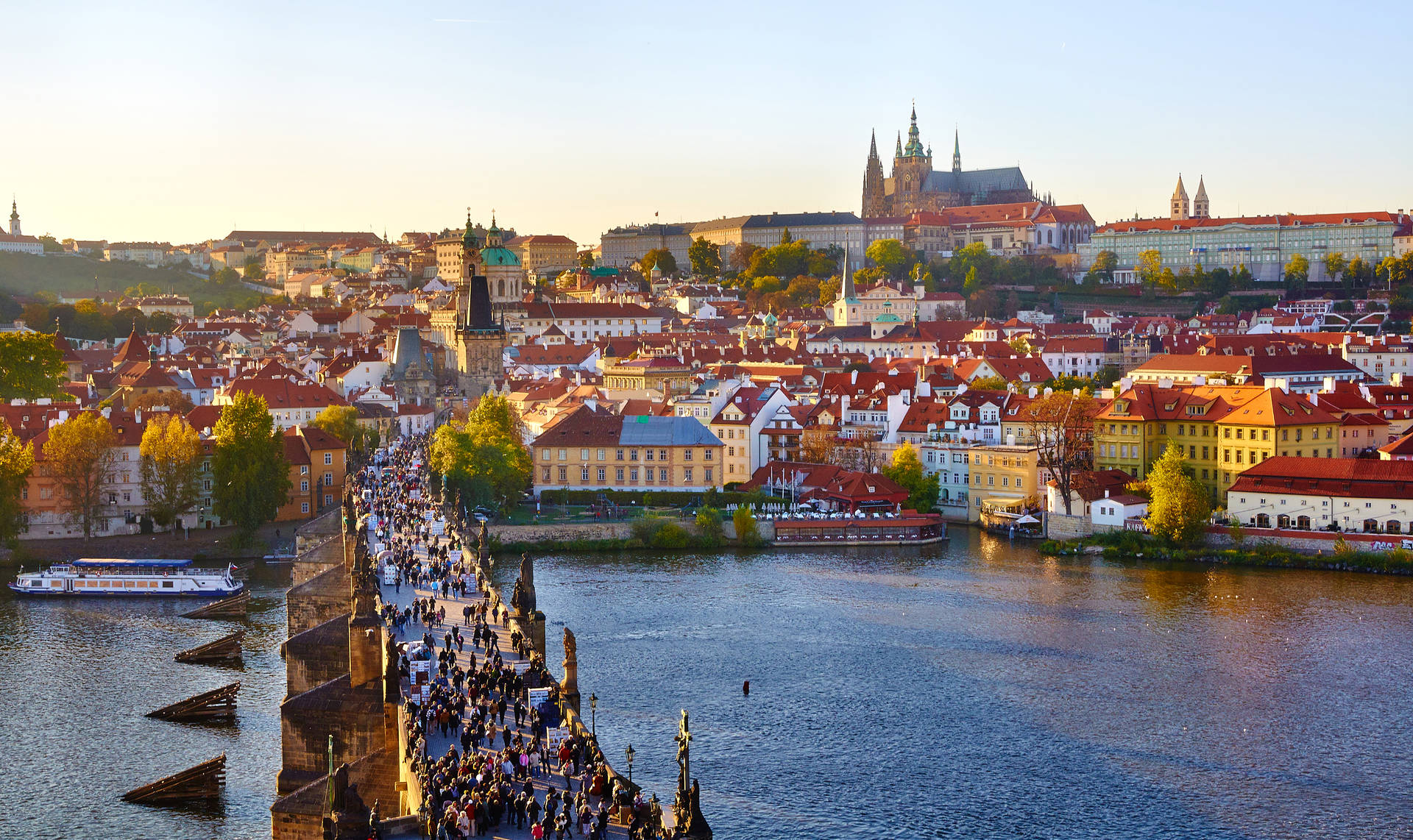
Prague has a trap nobody warns you about at first: it has been in the European Union since 2004 and yet you do not pay in euros. Everyone arrives with the same question, and everyone loses the first morning trying to work out why a beer costs 60 korunas and a tram ticket 50. Setting that aside, the city is exceptionally easy to plan: the old town, the Castle and the Jewish Quarter are all walked, and the only transport you genuinely need to understand is the airport connection and the funicular. This guide brings together what is worth knowing before you arrive: which travel pass to buy, what every admission costs in 2026, what the opening hours are, and how to split your days so you do not walk in circles.
Prague at a glance
- Currency: the Czech koruna (CZK, also written Kč). It is not the euro. One euro is around 24 to 25 korunas.
- Languages: Czech is the official language, but English is handled without difficulty on transport, in restaurants and in museums.
- Airport to centre: 30 to 40 minutes by public bus, from about 50 CZK.
- Getting around: one integrated system with no fare zones. A 90-minute ticket costs 50 CZK on paper, and the 24-hour and 72-hour passes cost 150 and 350 CZK.
- Don’t miss: Charles Bridge, Prague Castle and St Vitus Cathedral, Old Town Square with the Astronomical Clock, Josefov, and the views from Petřín.
- Book ahead: the guided Castle tour, the Jewish Museum circuit and the historic tram 42.
- Mind the closures: the Jewish Museum shuts on Saturdays and Jewish holidays, and St Vitus Cathedral admits no visitors during the Sunday morning service.
- Climate: continental. Warm summers, cold winters with occasional snow.
How many days you need
The advantage of Prague is that the two big concentrations of interest are adjacent: you come down from the Castle and you cross the bridge. Unless you specifically want the interiors of the monuments, two days covers the whole city; three days lets you slow the pace down and add an evening walk or an excursion.
Prague in 1 day
- Morning: Prague Castle first thing, with St Vitus Cathedral and Golden Lane.
- Midday: walk down Nerudova street, cross Charles Bridge and enter the Old Town.
- Afternoon: the Astronomical Clock on the hour, and Old Town Square with the Church of Our Lady before Týn behind it.
- Sunset: Josefov, which is empty at that hour and the best time to see it.
Prague in 2 days, the comfortable minimum
- Day 1, the medieval centre: Castle and St Vitus in the morning, then Charles Bridge, the Old Town and the Astronomical Clock at sunset.
- Day 2, Josefov and Petřín: the Jewish Quarter mid-morning, before 11:00, lunch, then the funicular up to Petřín in the afternoon, with the tower and the rose garden.
Prague in 3 days
- Day 1: Prague Castle, Malá Strana and Nerudova street.
- Day 2: Charles Bridge, the Old Town, Josefov and an evening in the centre.
- Day 3: Petřín in the morning and a day trip to Kutná Hora, Karlštejn or Terezín.
- With 4 days: add tram 42, the Old Town Bridge Tower and the mirror maze at Petřín.
Key areas for planning
Prague makes more sense by area than by list of monuments. These five group well:
- Hradčany and the Castle: the largest complex in the world by area, with the cathedral, the Royal Palace and Golden Lane, all on one climb.
- Malá Strana and the bridge: the Baroque quarter below the Castle, Nerudova street, and Charles Bridge with its 30 statues.
- Old Town: the Clock Square, the Church of Our Lady before Týn, St John Nepomuk Square and the towers of the Crucifixion.
- Josefov: the Jewish Quarter, with its synagogues and the old cemetery, five minutes from the square.
- Petřín and New Town: the green hill with the tower and the funicular, and next to it the Dancing House neighbourhood.
1. The currency: the Czech koruna
Prague has been in the European Union since 2004, but the currency is the Czech koruna (CZK, also written Kč), not the euro. It is the only real barrier to the trip and it takes ten minutes to solve: one euro is around 24 to 25 korunas, so a 450 CZK ticket is about 18 euros. It also helps to read prices for what they are, because a 600 koruna ticket is not expensive in euros even though the number looks like thousands.
Two practical rules. First, always pay in korunas: if the terminal offers you the choice of being charged in korunas or euros, take korunas every time, because the places that accept euros usually apply an unfavourable exchange rate. Second, cards work almost everywhere, including bars and restaurants, and contactless payment is standard, but carry a few hundred korunas in cash for market stalls, small admissions and tips.
- Tell your bank before you travel so it does not block payments abroad.
- Exchanging on a card is usually better than changing cash, although the refund takes a few days.
- Be wary of currency exchange offices in the centre: many of them work as tourist traps.
- The Czech Republic is studying adoption of the euro, but it is not planned in the short term, so do not expect to pay in euros.
2. The language: four words are enough to get by
Czech has a reputation for being difficult and it is, but for a tourist trip English gets you everywhere you need. Staff on transport, in restaurants, in hotels and in museums handle it without difficulty, and menus usually carry an English version.
Even so, four Czech words open the door: děkuji (thank you), prosím (please), dobré ráno (good morning) and, in any bar, pivo (beer). With those four, half of every interaction resolves itself with a gesture.
3. From the airport to the centre
Prague Václav Havel Airport (PRG) sits about 17 kilometres from the centre and is smaller and better organised than other airports of comparable size. There are two sensible ways in and one to rule out.
- Bus 59 to Nádraží Veleslavín, then change to metro line A. This is the option the airport itself recommends: the bus leg takes about 15 minutes and the standard 90-minute ticket costs 50 CZK on paper or 46 CZK in the app.
- Bus 100 to Zličín, then change to metro line B. Slightly slower, but very convenient if you are staying in Zličín or Anděl.
- Airport Express: a direct bus to Hlavní nádraží central station, comfortable if you are arriving from or leaving for a train. But it has its own 200 CZK fare and is not covered by any travel pass, so it only makes sense if it saves you a change with luggage.
- Taxi or a ride-hailing app: the most comfortable option with bags and the most expensive, between 500 and 600 CZK depending on traffic. Be wary of drivers offering a fixed price in the airport hall with no meter.
One detail that saves time: buy your ticket before you board, at the machines in the terminal or directly in the PID Lítačka app. Paper tickets get stamped in the yellow machine as soon as you get on, and travelling on an unstamped ticket is fined at 1,000 CZK.
4. Getting around: metro, tram and ticket prices
Prague has three metro lines (A, B and C), a very extensive tram network, buses, trolleybuses and river ferries crossing the Vltava. All of it forms one integrated system (PID) with no fare zones: a single ticket covers any journey within the city, with unlimited changes inside its validity window.
For a visitor, the money is decided on the first morning. These are the official prices, increased on 1 January 2026:
- 30-minute ticket: 39 CZK on paper, 36 CZK in the app. One journey, with unlimited changes inside the half hour.
- 90-minute ticket: 50 CZK on paper, 46 CZK in the app. The most useful one if you move several times in a day.
- 24-hour pass: 150 CZK on paper, 140 CZK in the app. Unlimited from the moment you validate it, not by calendar day, and it includes the Petřín funicular.
- 72-hour pass: 350 CZK on paper, 340 CZK in the app. Cheaper than buying three 24-hour passes, which would come to 450 CZK.
- Monthly pass: 550 CZK. Only worth it from about five days of stay.
- Petřín funicular: not covered by the 30- or 90-minute tickets. It has its own ticket, 100 CZK at the station or 90 CZK in the app, unless you hold a 24- or 72-hour pass.
The quick calculation: with the 72-hour pass at 350 CZK, any visit involving four or five journeys a day comes out cheaper than buying single tickets. Under-15s and over-65s travel free with documentation, and the historic tram 42 ticket gives a discount on the Prague City Tourism towers.
- Tram 42 is the historic line with old carriages: it is a sightseeing run on rails that needs no planning.
- The PID Lítačka app is the most convenient option: you buy tickets without hunting for a machine and it gives slightly lower prices.
- The Old Town, Malá Strana, Josefov and the bridge are walked; metro and tram cover the rest.
- Vltava ferries run on the same ticket, but only from March to October.
5. Charles Bridge: the hour changes everything
Charles Bridge, with its 30 statues, is the obligatory Prague postcard. The bridge itself is free and you can cross it at any hour, but the timing matters a lot: between 10:00 and 16:00 it is packed with groups, and the umbrellas get in the way of the photo. Before 08:00 in the morning it is almost empty and has the cleanest light of the day.
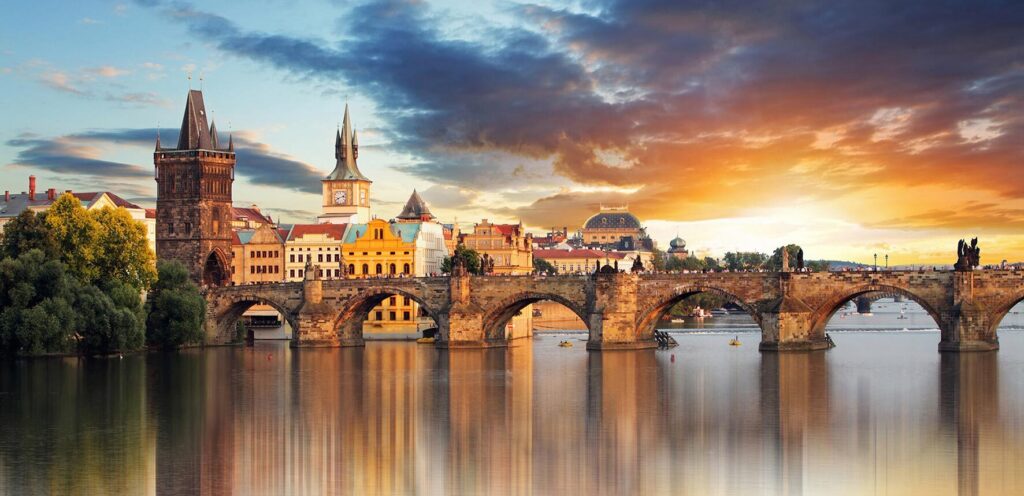
There are two towers, one at each end, and climbing either gives you some of the best free views in the city. The Old Town Bridge Tower, on the square side, costs 340 CZK, or 230 CZK reduced and 680 CZK for a family, and is bundled with the tram 42 ticket, which carries a discount. It is a narrow climb of nearly 70 metres, so it is not the option if the thought of being stuck with strangers does not appeal.
One note on the bridge: it is not just a walk. It is the one place where the history of the city reads at a glance, because almost every statue has a story behind it. In the afternoon musicians, painters and stalls appear, which makes it the liveliest place in the centre after dark.
6. The Astronomical Clock and the Old Town
On the facade of the Old Town Hall, every hour on the hour the procession of the Apostles passes by, a small parade of figures that move as the bells ring. It is the most photographed spectacle in the city, and it is worth seeing from the square at a little distance rather than from underneath.
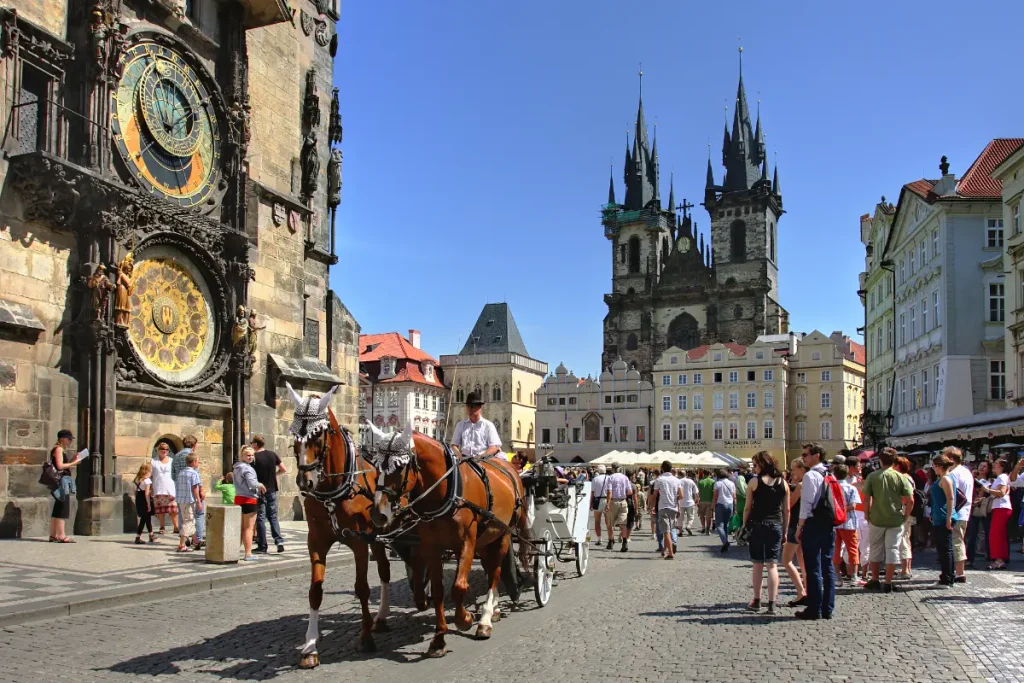
The square works as an open-air theatre. On it are the Church of Our Lady before Týn, with its asymmetric roofs, the Jan Hus statue, and the café terraces under the arcades. In December one of the largest Christmas markets in Europe is set up here. Two concrete details: the Old Town Hall tower lets you see the clock up close and climb to the upper gallery, costs 350 CZK and now has a lift; and a few metres away is St John Nepomuk Square, the classic shot of the Gothic nave of the church of the same name. From 1 January to 31 March the tower opens later, 10:00 to 19:00, and from April to December 09:00 to 20:00.
7. Prague Castle and St Vitus Cathedral
Prague Castle is the largest ancient complex in the world, at around 70,000 square metres, and it is a UNESCO World Heritage Site. The whole site, with its courtyards, gardens and lanes, is free and can be walked freely, though you do pass a security check. What you pay for is the interiors of the monuments.
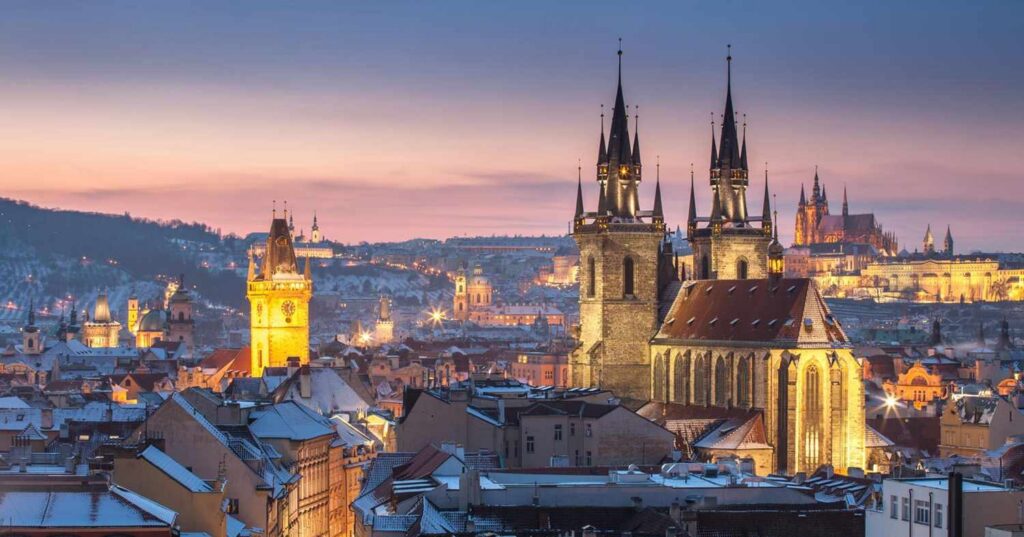
The visit is sold in circuits, and there is no separate ticket for the cathedral. The basic circuit costs 450 CZK, or 300 CZK reduced and 950 CZK for a family, and covers four places: the Old Royal Palace, St George’s Basilica, Golden Lane with the Daliborka tower, and St Vitus Cathedral, which is the one that justifies the trip. The exhibitions at the Picture Gallery, the Powder Tower and the Rosenberg Palace cost 300 CZK more, and the cathedral’s Great South Tower is 200 CZK on top, with 287 steps and the best terrace in the castle.
Three details that save time and money. The ticket is valid for two consecutive days, with one entry per building, so you can split the visit over two mornings. The site opens 06:00 to 22:00 all year and the historic buildings 09:00 to 17:00, until 16:00 in winter, with last entry 20 minutes before closing. And St Vitus Cathedral closes on Sunday mornings for the service, so on Sunday you get in from 12:00.
A free classic is the changing of the guard: the sentries at the gates change every hour on the hour all day, and the official ceremony with fanfare and flag ceremony is at 12:00 in the First Courtyard, lasts about 15 minutes and costs nothing.
8. Josefov: the Jewish Quarter
Josefov, the former ghetto, is one of the districts in Europe with the most history per square metre. What you need to know before going: since 2024 you no longer buy a ticket per synagogue, but a single 600 CZK circuit, or 400 CZK for students and under-26s, 200 CZK for children aged 6 to 15 and free for under-6s. It covers the Old New Synagogue, the Spanish Synagogue, Maisel, Pinkas and the Old Jewish Cemetery.
The full circuit takes 2 to 3 hours. Hours run 09:00 to 18:00 from April to October and 09:00 to 16:30 from October to March, closing on Saturdays and Jewish holidays, and ticket sales end half an hour before closing. Two practical tips: avoid the 11:00 to 15:00 window, when the circuit is packed, and note that guided tours in English run at 10:30 and 14:00.
What you do not pay for, and which is worth it anyway: the streets of the district, the Jewish Community Square with its bookshops and cafés, and above all reading a little before you go into the cemetery. The Old Jewish Cemetery, in use until 1787, is included in the same ticket, and understanding what you are looking at changes the visit completely.
9. Petřín: the tower and the funicular that has just reopened
If you want the best panorama in Prague, go up Petřín, the green 327-metre hill above Malá Strana. And there is a piece of news that matters for any 2026 visit: the Petřín funicular reopened on 22 September after almost two years closed for works. It runs every day from 07:00 to 22:15, with departures every 10 minutes, using new fourth-generation carriages.
The Petřín Tower was built in 1891 for the Jubilee Exhibition as a free interpretation of the Eiffel Tower, at a scale of 1:5. It stands 58.70 metres tall, climbs 299 steps, and its viewing platform is at the same height as the original Eiffel Tower. Admission is around 250 CZK, with a reduced rate for seniors and a guided tour included.
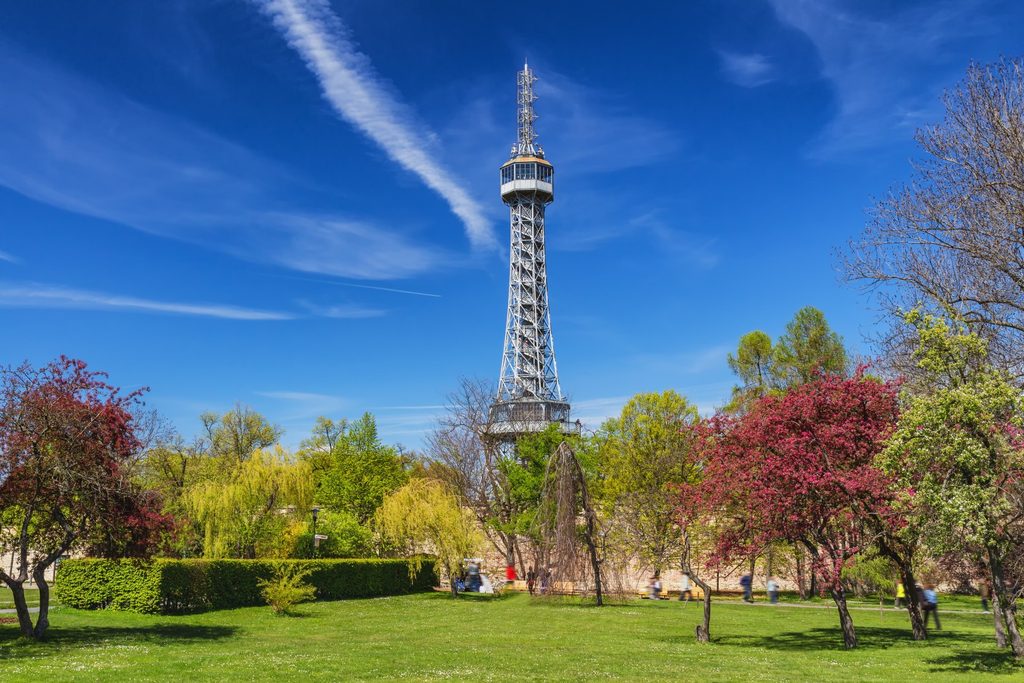
Important about the funicular: the 30- and 90-minute tickets are not valid. You need its own ticket, 100 CZK at the station or 90 CZK in the app, or you need to hold a 24- or 72-hour pass, which includes it; if you have the pass, the ride up is free. The alternative is to walk, which is 15 to 20 minutes of slope, or to take the tram as far as Pohorelec, near the top.
Up top, besides the tower, there is the mirror maze, the rose garden and the Štefánik Observatory, which opens in the afternoon and closes on Mondays. The park itself is free and always open. The walk back down through the castle gardens, or along the Lennon Wall, is one of the prettiest strolls in the city, and almost nobody mentions it in first-week guides.
10. The Dancing House and Czech beer
Along the Vltava, between Malá Strana and New Town, stands the Dancing House, the building by Vlado Milunič and Frank Gehry that looks like it is leaning into a dance move, and that was controversial when it went up. The public space is free and the rooftop has a good view of the Castle; the gallery costs 225 CZK, and you can visit the terrace for free by ordering a drink at the glass bar on the top floor.

And next to it, at any hour, is what really moves this city: beer. The Czech Republic drinks more beer than water, and a draught Pilsner in an ordinary pub costs around 50 to 70 CZK. You do not need to hunt down secret bars: any pub with warm light, locals and a good Pilsner or Kozel on tap does the job. There is only one rule worth having: always drink what is on tap, because that is what is fresh and what will not be overcharged.
Day trips from Prague
If you have a day to spare, there are three trips done by train that give the journey another dimension:
- Kutná Hora, 75 kilometres away: the medieval silver town, with the Cathedral of St Barbara and the Sedlec Ossuary, one of the most striking places in the Czech Republic. The direct train takes a little over an hour and a quarter.
- Karlštejn, about 30 kilometres away: the Gothic castle often said to have inspired the Disney castles. It is the easiest to combine, because it sits almost on the train line towards the coast.
- Terezín, about 50 kilometres away: the small fortified town that served as a concentration camp and ghetto during the Second World War. It is an uncomfortable and very important visit, so allow time and go with your head prepared.
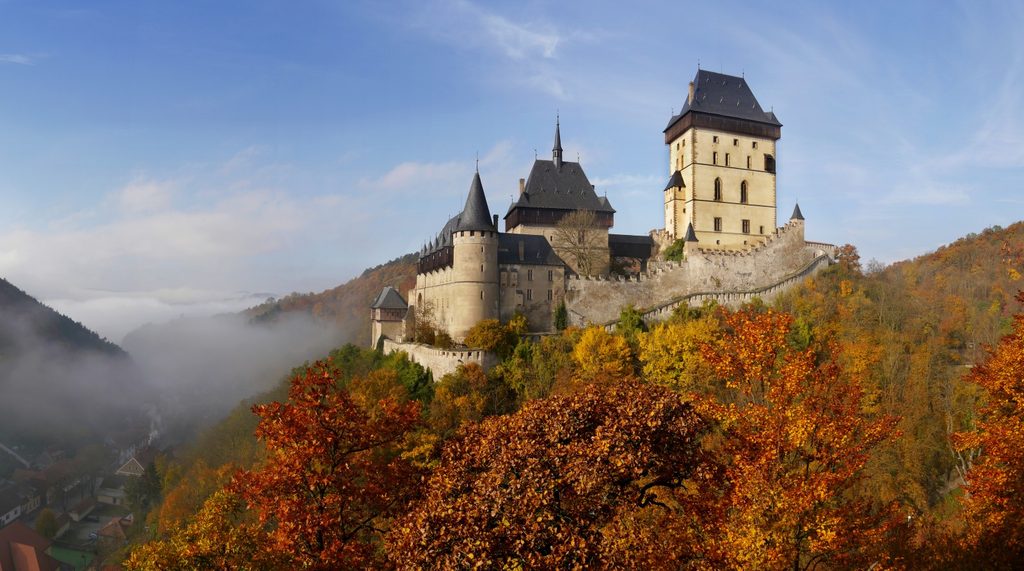
All three are reachable on ordinary public transport and with the same integrated ticket. Entry to the Sedlec Ossuary and St Barbara’s Cathedral requires a combined ticket bought on site.
Repeated mistakes, and how to avoid them
- Expecting to pay in euros. Prague is in the EU, but the currency is the Czech koruna.
- Boarding the Petřín funicular with a 90-minute ticket. It is not valid. You need its own ticket or a 24- or 72-hour pass.
- Going to Josefov on a Saturday. The Jewish Museum closes on Saturdays and Jewish holidays.
- Going to St Vitus on a Sunday morning. It is closed for the service and opens at 12:00.
- Looking for a separate cathedral ticket. It does not exist; it is inside the Castle circuit.
- Failing to stamp a paper ticket. It is fined at 1,000 CZK.
- Crossing the bridge at midday. Before 08:00 it is empty and better lit.
Your plan in Trively, without depending on signal
Prague is walked and climbed, and the only moments when signal really fails are the worst ones: the metro tunnel, the funicular going up, and the fog on Petřín. In Trively you can keep the itinerary with the visit times you have already paid for, the booking codes for the Castle and the Jewish Museum, the transport fares and the metro map in one place, available even offline. It does not replace buying tickets officially or the information from PID, the airport, the Castle, Prague City Tourism or the Jewish Museum; it exists so that the plan does not live in scattered screenshots or in the memory of a single traveller.
And an honest note: the prices, hours and fares in this guide were checked on 26 September 2026 against official sources, among them PID, Prague Airport, the Castle website, Prague City Tourism and the Jewish Museum in Prague. Transport fares last changed on 1 January 2026 and monument prices are reviewed frequently, so it is worth going back to the official source before you pay.
With the 72-hour pass, the Castle and the Jewish Museum booked ahead, and the areas grouped by day, Prague is enjoyable without overspending. The rest, the pub that calls you out as you leave the Old Town Bridge Tower, the music on the bridge at dusk and the exact light for the way down, the city provides when you arrive.