
Berlin Travel Guide: 10 Must-Sees, Prices and a Day-by-Day Plan
What to see in Berlin and how to plan it: real public transport fares, Reichstag dome and TV Tower ticket prices, how to get in from the airport, and one-, two- and three-day itineraries.
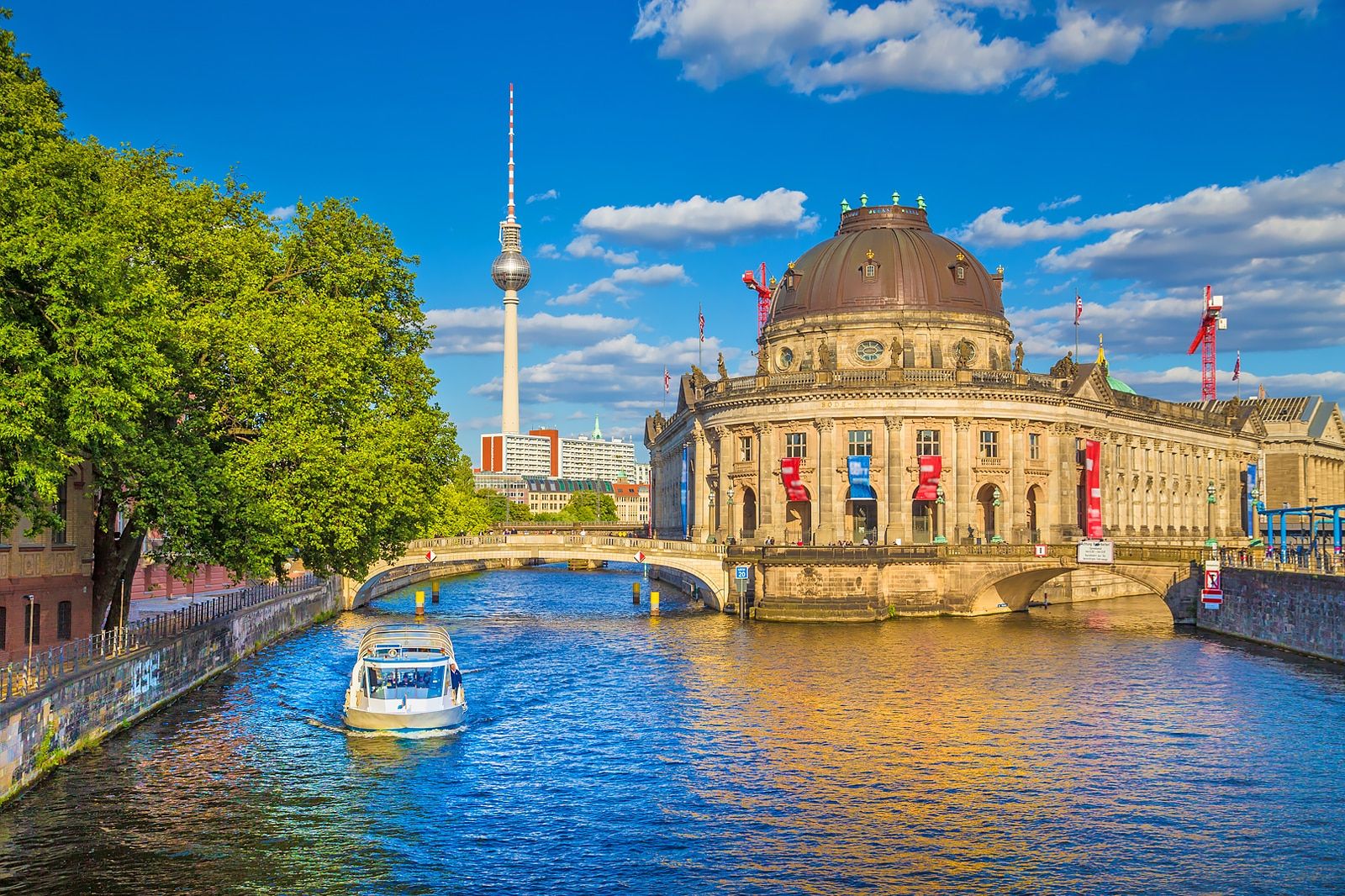
Berlin is not beautiful in the classical sense, and that is precisely what makes it easy to fall for. It is a city to understand: the history is on every corner and the cultural offer is among the largest on the continent. The good logistical news is that almost everything that matters is in the centre or very close to it, the public transport genuinely works, and several of the most remarkable sights are free. The real complication is a different one: plenty of guides still doing the rounds online recommend the Pergamon Museum, which has been closed for years. This guide brings together what is worth knowing before you arrive, with checked data: which travel pass to buy, what every admission costs in 2026, which visit is closed and how to split the days so you do not cross the city five times.
Berlin at a glance
- Currency: the euro. Almost everything takes a card, but carrying some cash is sensible.
- Languages: German is the official language, but English is handled without difficulty on transport, in museums and in almost every restaurant.
- Airport to centre: 23 minutes by airport express to the main station for EUR 5.
- Getting around: one system for U-Bahn, tram, S-Bahn and bus. A single AB zone ticket is EUR 4.
- Free highlights: 2,711 concrete slabs, 1.3 km of painted wall and a 1.4 km open-air memorial.
- The fact that changes an itinerary: the Pergamon Museum is closed until 4 June 2027. Museum Island is still open and worth the trip, but with a different plan.
1. Money: the euro, the card and tipping
Berlin uses the euro and almost everything is paid by card, including the markets and most of the bars. Even so, some small places still prefer cash, and at a market or in an eastern bar having notes to hand always saves an argument. For everyday spending, EUR 50 or 60 covers the city without effort: a coffee, a currywurst and three or four metro or tram journeys.
And the local habit: tipping. There is no fixed percentage and it is not compulsory, but rounding the bill up to the next euro or leaving 5 to 10 per cent when the service has been good is appreciated. You can pay by card without any problem; cash is for street stalls and for the odd old bar in the east.
- A contactless card for daily life and some cash for the market and small bars.
- Tipping: round up to the next euro or leave 5 to 10 per cent if the service was good.
- Water is not served free in restaurants: order it bottled or sparkling, which is the most typical choice.
- Cash machines are everywhere, but many small shops no longer give change, so carry small notes.
2. Language: useful German, English everywhere
In the centre and at the tourist sites English is spoken without difficulty, and museums, transport and nearly every route-planning app are in English. Even so, a handful of German words work very well at markets and in neighbourhood bars: “Danke” (thank you), “Bitte” (please or you are welcome) and “Hallo” (hello).
And two words that explain the character of the city better than any guide: Gemuetlichkeit, that feeling of being comfortable somewhere warm and cosy, and Kaffee und Kuchen, the afternoon coffee and cake, a national institution that is genuinely lived here at four in the afternoon.
3. From BER airport to the centre: 23 minutes and EUR 5
Berlin Brandenburg Airport (BER) lies to the south-east of the city. The normal choice is the FEX airport express, which reaches the main station (Hauptbahnhof) in about 23 minutes and leaves every 15 minutes. The alternatives are the S9 and S45 and the RE and RB regional trains, which take a little longer but reach more districts.
The key is the ticket: the airport is in zone C, so you need an ABC ticket, which has cost EUR 5 since 1 January 2026. A single ticket is valid for 120 minutes and allows changes, although in one direction only. You can buy it from the machines in the terminal, at the counters or in the BVG app, and it can also be paid for by contactless card.
For heavy luggage, a large group or a very early start, the alternative is a taxi or a car booked through an app: from the airport to the centre it is usually about 40 minutes and between EUR 60 and 70, depending on traffic. Berlin taxis have no night surcharge, so the rate is the same day and night, and one car takes up to four passengers.
One detail that saves money for the whole trip: the airport ticket belongs to the same system you use every day in the city. It is therefore worth deciding early which zones you will cover and buying the right pass from the start.
4. Getting around: the fares and two trams that double as sightseeing
The Berlin network (VBB and BVG) is among the best in Europe: U-Bahn, S-Bahn, tram, bus and ferry under a single system and a single ticket. The zoning is simple: zone AB covers the centre and practically everything of tourist interest, while zone C is only needed for the airport and for Potsdam.
- Single ticket AB: EUR 4, valid 120 minutes with changes permitted.
- Single ticket ABC: EUR 5, for the airport and Potsdam.
- 24-hour ticket AB: EUR 11.20. It starts paying for itself on the third journey of the day.
- 24-hour ticket ABC: EUR 12.90, for anyone who wants the train on arrival day.
- Four-journey ticket AB: from EUR 12.40, the best value if you make four longer trips.
- Short-trip ticket: from EUR 2.80 for three U-Bahn or S-Bahn stops, or six tram or bus stops.
- Berlin WelcomeCard: EUR 28.50 for 48 hours in zone AB. It is not cheap, but it includes discounts of up to 50 per cent at more than 170 partners, the TV Tower among them.
Two practical warnings. First, a paper ticket has to be validated in the yellow machines at the station: inspections are unannounced and the fine starts at EUR 60, so validating is not a minor detail. Second, the BVG or VBB app validates the ticket at the moment of purchase and removes that step entirely.
And two trams that double as a ride with a normal ticket, which is the cheapest way to see the city: the M100 runs along Unter den Linden, past Museum Island, the Brandenburg Gate and the Reichstag, while the M1 follows the Spree past the East Side Gallery, the best known surviving stretch of Wall. The U2 is the useful line for a first day: it links Alexanderplatz and Potsdamer Platz straight through the centre, and on the way you can get off at Stadtmitte or Klosterstraße, both a couple of minutes from Museum Island. One caveat: the Brandenburg Gate is not on the U2; you reach it on the U5 (Brandenburger Tor) or by S-Bahn, and from Alexanderplatz it is a fifteen-minute walk.
Berlin is also very walkable. Unter den Linden, the Tiergarten, the Mitte district and the Brandenburg Gate area are all better on foot than by tram, and the Museum Island underground station, open since 2021 on the U5, sits right by the river.
5. The Brandenburg Gate and Pariser Platz
The Brandenburg Gate is the absolute symbol of the city: the old city entrance that became a stage for history, from Napoleon’s march to the fall of the Wall. It stands on Pariser Platz and is best seen early or at dusk, when the low light sets it glowing above the Unter den Linden boulevard. It is free and there is nothing to book.
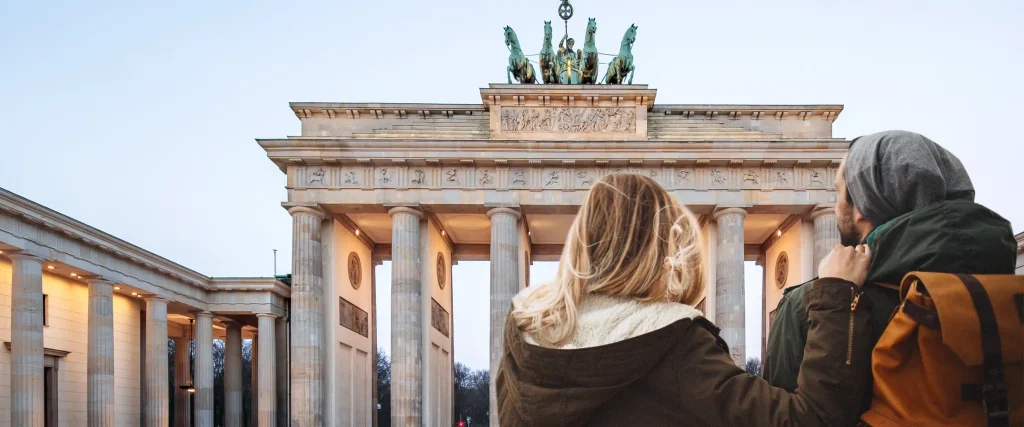
From the gate it is a five-minute walk to the Memorial to the Murdered Jews of Europe, that sea of 2,711 slabs of concrete walked in silence, and in the other direction to the Reichstag. It is the densest history per square metre in the city and the whole area can be done on foot. The underground information centre beneath the slabs is free and short: better seen calmly than squeezed between two other visits.
6. The Reichstag and its dome: free, but with a booking
The Reichstag, the German parliament, offers one of the best free plans in the city: going up to the glass dome, with its spiral of mirrors and 360-degree views over the government district. Entry is free, but you have to book in advance on the Bundestag website, and there are two details worth respecting.
- Booking only opens for the current and the following month, so you cannot plan it months ahead.
- Photo ID is required for everyone aged 16 or over, and also for those aged 14 and 15.
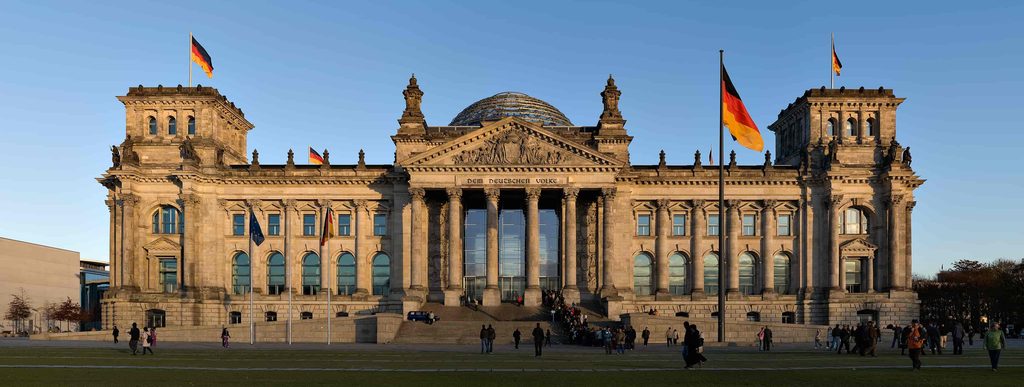
Admission is every quarter of an hour, from 8:00 to midnight, with last entry at 21:45. The visit lasts about 20 minutes and includes a free audio guide available in twelve languages, Spanish among them. If places are left free, you can register in person at the visitor centre on the Platz der Republik, but the confirmation must be issued at least two hours before your visiting time.
An important note for 2026: the dome closes for maintenance from 14 to 18 September, from 28 September to 2 October and from 19 to 30 October. During those periods the outdoor roof terrace stays open, so it is worth checking the calendar before fixing the day. The building also carries the last page of German history: rebuilt after the war, it was the scene of reunification.
7. The Wall: East Side Gallery, Bernauer Strasse and Checkpoint Charlie
The Berlin Wall divided the city for 28 years, from 1961 to 1989, and it is remembered today at several quite different places. The most photographed stretch is the East Side Gallery, 1.3 km of wall beside the Spree covered in graffiti, including the famous “fraternal kiss” between Brezhnev and Honecker. It is free, open at any hour and takes about twenty minutes on foot.
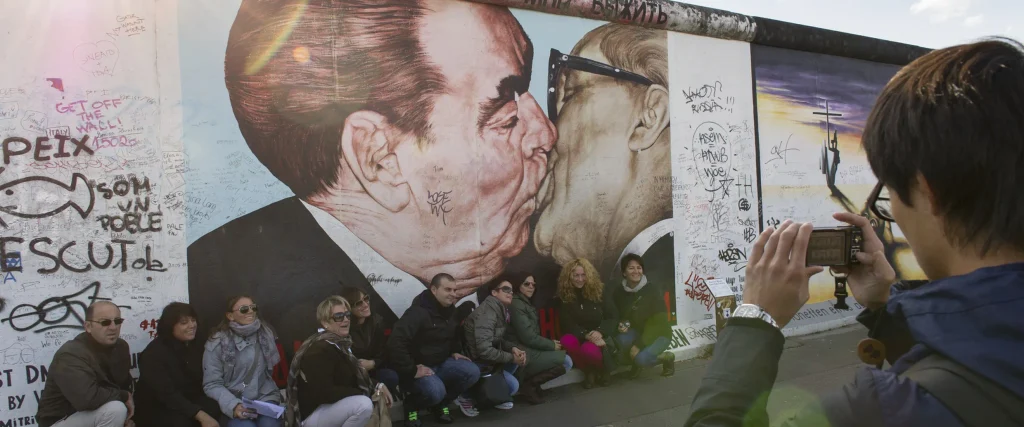
The gallery visitor centre is at Muehlenstrasse 73 and opens every day from 10:00 to 17:00; guided tours cost EUR 5, or EUR 3 reduced. To really understand the Wall, the key place is somewhere else: the Berlin Wall Memorial on Bernauer Strasse, where 1.4 km of wall, watchtower and death strip are preserved as they stood. The open-air exhibition is open every day from 8:00 to 22:00 and free; the documentation centre and viewing tower run from Tuesday to Sunday, 10:00 to 18:00, with last ascent at 17:45.
On Checkpoint Charlie it is worth clearing up a common confusion: what you see at street level is free and accessible at any hour, with the guardhouse, the control post and the outdoor panels. It is not a museum. The Berlin Wall Foundation is still developing an educational and memorial concept for the site, and the paid museum sold as the “Checkpoint Charlie Museum” is a separate commercial attraction with its own ticket price. For rigorous historical context without the gimmicks, two free options work very well: that same site and the Topography of Terror on Niederkirchnerstrasse, open every day from 10:00 to 20:00, free to enter and with no need to book.
8. Museum Island, with the Pergamon still closed
Museum Island, in the heart of the Spree, is a World Heritage Site and one of the most important concentrations of art in the world. But the bad news comes first: the Pergamon Museum has been closed since 2023 and does not reopen until 4 June 2027, after a full renovation of the building. Anyone arriving with the Ishtar Gate and the Market Gate of Miletus in mind will find a closed building.
The good news is that the island remains a first-rate visit, with other contents. The Neues Museum above all holds the bust of Nefertiti, probably the most famous single object in Berlin; the Bode Museum is the place for medieval sculpture and Byzantine art; and the Alte Nationalgalerie, which holds nineteenth-century art, is the building at the centre of the island’s 200th anniversary celebrations in 2026.
To compensate, the National Museums Foundation has set up a temporary exhibition next door called Pergamonmuseum. Das Panorama. It includes selected pieces from the collection and a large 360-degree panorama of the ancient metropolis. It is the best way to understand what is being restored before going back in 2027.
Two more things about the island. There is a Museum Island pass for EUR 24, valid for one day, which pays off if you visit two buildings or more. And many museums in the collection require a timed booking in high season, so it is worth checking each calendar before you go.
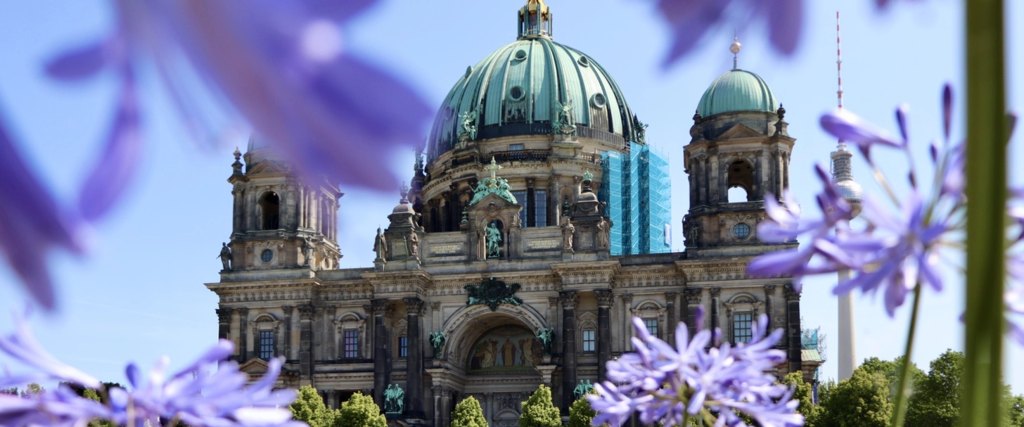
On the same axis stands the Berlin Cathedral (Berliner Dom), the great brick and stone dome that dominates the river. You can climb to the upper gallery for the best view of the centre and the Spree, and it is far more relaxed than the TV Tower because there is no timed ticket and no entry fee. It is the best plan on the island if time is short.
9. Alexanderplatz and the TV Tower: the most expensive view in the city
The best-known square in eastern Berlin is Alexanderplatz, presided over by the TV Tower (Fernsehturm), 368 metres tall and the tallest building in Germany. Its revolving sphere is still the most famous view in the city, and the Sphere restaurant inside it turns once an hour.
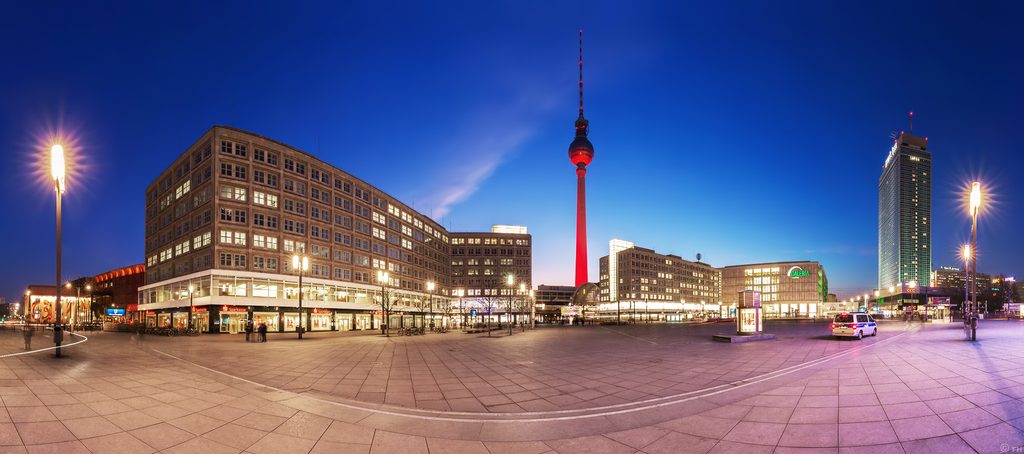
The observation deck is at 203 metres and the price has risen considerably: from EUR 20 bought online and around EUR 24.50 at the ticket desk. Three warnings. First, entry is by a reserved time slot and your time on the deck is limited to 45 minutes. Second, there is a security check that an online ticket does not remove, it only saves the queue at the desk. Third, the tower is not accessible to wheelchair users or people with severely reduced mobility, because evacuation is by 986 steps.
Opening hours run 9:00 to 23:00 from March to October and 10:00 to 23:00 from November to February. Anyone planning to dine in the sphere should know that the menu at the Sphere restaurant by Tim Raue is around EUR 154: it is an experience, not a meal. Two steps from the square are the Red Town Hall (Rotes Rathaus) and the reconstructed corner of the Nikolaiviertel, the ideal stop for a coffee once it gets late.
10. The Tiergarten and what to eat: currywurst, doner and Markthalle Neun
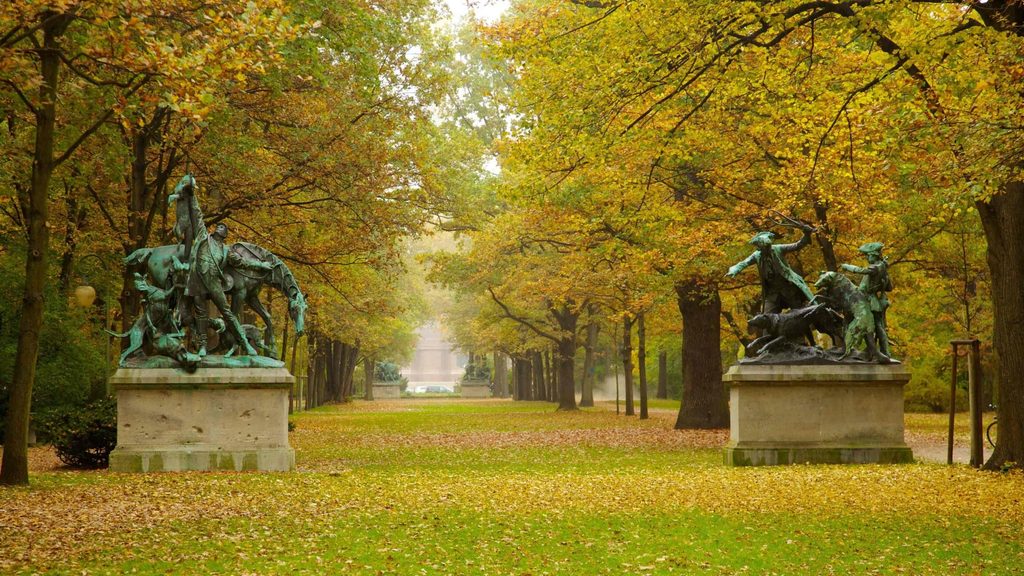
The Tiergarten is the great green lung of the centre: a huge park with the Victory Column (Siegessaeule) at its heart, lakes, gardens and long paths. Crossing it on foot end to end takes about 30 minutes at a good pace, less by bike, and it is the best way to breathe between so many museums. On the western side, next to the column, stands the Soviet War Memorial, and at the far end of the park you reach the Memorial to the Murdered Jews.
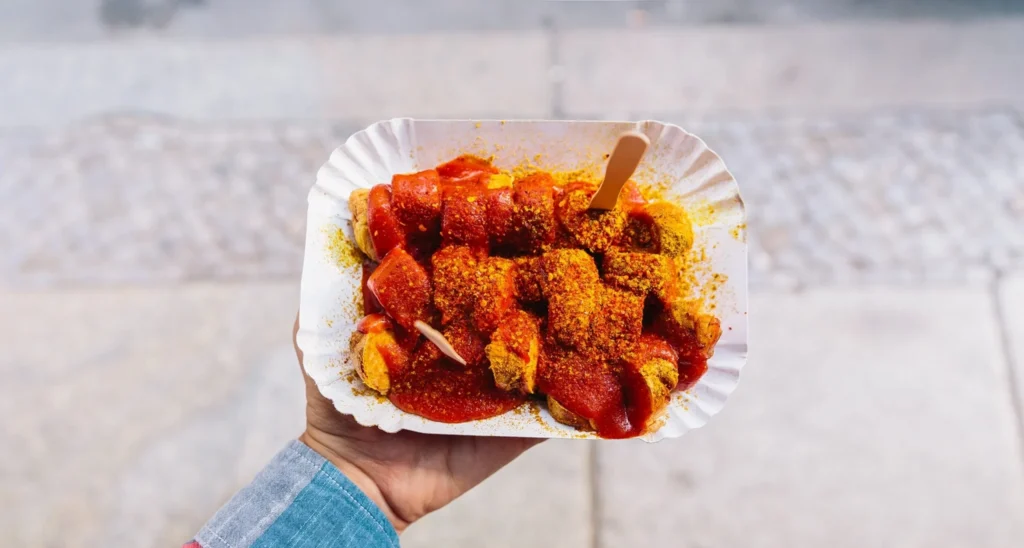
And for food, the usual: currywurst, the sausage with curry sauce and ketchup that is almost a religion here, and the doner, which Berlin popularised across Europe. For something different there is the Markthalle Neun in Kreuzberg, with its bakeries, brewery and food stalls. The big market is Fridays from 12:00 to 18:00 and Saturdays from 10:00 to 18:00; Monday to Wednesday there is a small market at midday, Thursday has street food in the afternoon and it is closed on Sundays.
For the neighbourhood plan, two notes. The East Side Gallery and the Warschauer Strasse area hold a good share of the nightlife and the street food, and they are easy to combine with the gallery in the same afternoon. And a coffee with cake in mid-afternoon, in an eastern district such as Friedrichshain or Prenzlauer Berg, is still the easiest way to understand why the afternoon tea is an institution here.
How to split three days without crossing the city five times
- Day 1, historic centre: Brandenburg Gate, Memorial to the Murdered Jews, Reichstag, Museum Island and Berliner Dom. All of it is walked in a single arc. If the Reichstag dome is booked for that day, start there first thing.
- Day 2, the Wall and the east: morning at the Berlin Wall Memorial on Bernauer Strasse, afternoon at the Topography of Terror and Checkpoint Charlie, finishing at the East Side Gallery at sunset, with dinner in Kreuzberg or at Markthalle Neun.
- Day 3, Tiergarten and Alexanderplatz: morning in the park and at the Soviet War Memorial, afternoon at Alexanderplatz, with the TV Tower booked for the end of the day, when the light is best.
With the Reichstag dome booked, a 24-hour transport ticket bought in zone AB and the areas grouped by day, Berlin is enjoyed without overspending. The rest, the exact light on the Brandenburg Gate, the afternoon coffee and cake and the right hour for the skyline, the city provides once you arrive.
And one honest note: the prices, hours and fares in this guide were checked on 26 September 2026 against official sources, among them the Verkehrsverbund Berlin Brandenburg (VBB) and BVG, the Bundestag, the National Museums Foundation, the Berlin Wall Foundation, the Topography of Terror, Markthalle Neun and the Berlin TV Tower website. Suburban transport fares last changed on 1 January 2026 and the Pergamon Museum does not reopen until 4 June 2027, so it is worth returning to the official source before you pay.